Physical Address
304 North Cardinal St.
Dorchester Center, MA 02124
Physical Address
304 North Cardinal St.
Dorchester Center, MA 02124

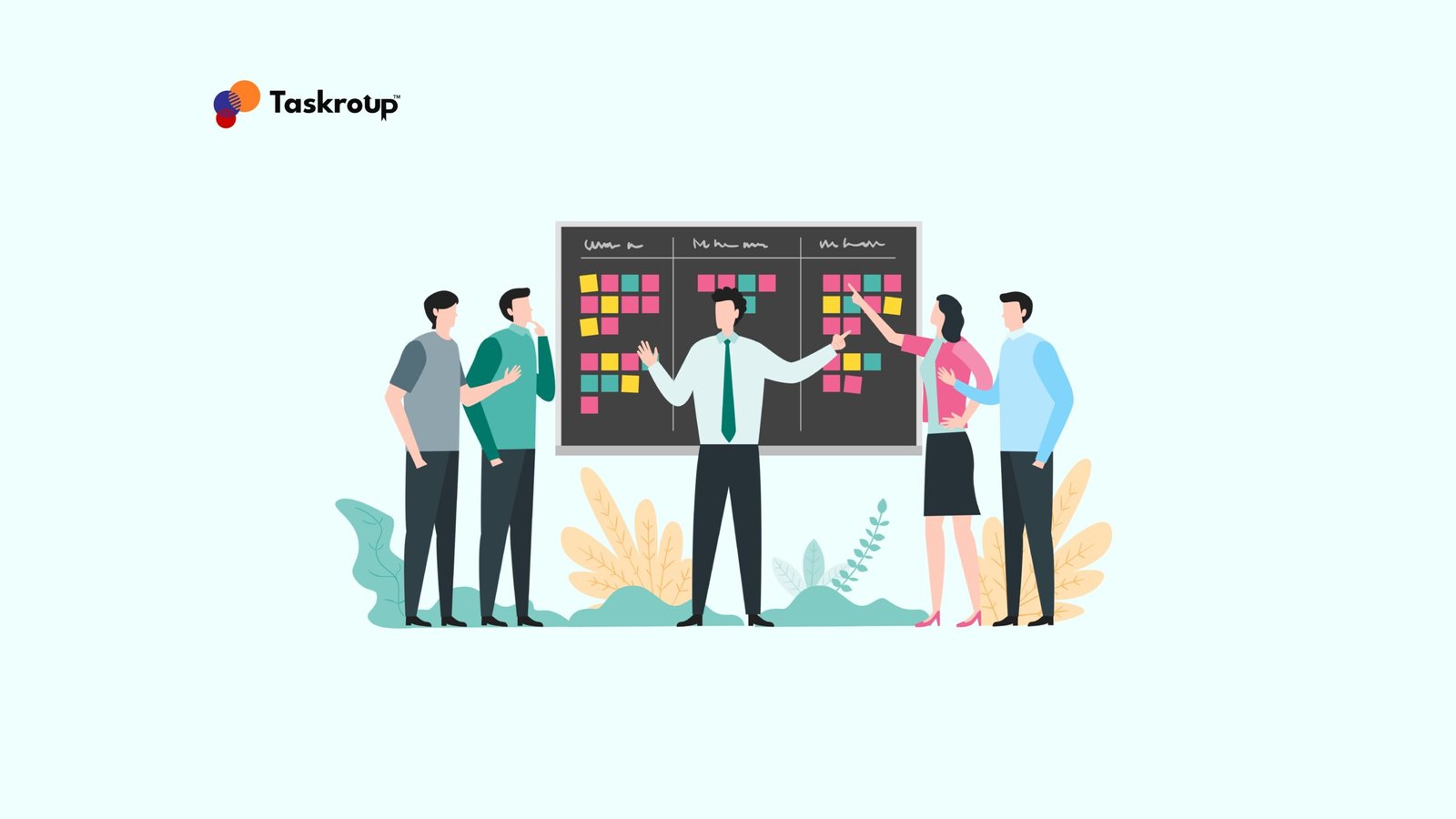
Agile Project Management Software is an important tool to assist contemporary teams in dealing with change, collaboration, and constant delivery. With organizations becoming more and more agile in the ways of work, the selection of methodology is becoming as important as the selection of the correct tools. At Taskroup, we are aware that agile projects require flexibility, transparency and real-time coordination in order to achieve successful results.
Agile project management places emphasis on dividing work into small and manageable iterations instead of trying to bring everything on the table. The method enables rapid change adaptability by teams, constant feedback collection and enhancement of the product at each lifecycle stage. Although agile is traditionally related to software development, its concepts are now all over the industries, including manufacturing, marketing, operations, and IT services.
In order to assist teams to select the appropriate approach, we would compare five common project management methodologies and look at the extent to which they would support agile projects.
Waterfall is among the most conventional project management methods. It is linear and has a sequential design in which the steps of planning, design, development, testing, and delivery can only be undertaken one right after another. This approach is effective when the requirements of the project are well established and can hardly be altered.
Nevertheless, the agile projects usually feature changing requirements and constant feedback. This renders Waterfall less adaptive and difficult to change in the middle of the way. Although it may also be applied in hybrid settings, the teams should be ready to change the timelines and dependencies in case of some changes. Waterfall can be appropriate when there are high compliance requirements but not in agile teams that move quickly.
One of the most common frameworks applied in agile environments is scrum. It focuses on brief development cycles referred to as sprints, unrelenting enhancement, and the tight cooperation of team members. A typical Scrum team consists of a product owner, a scrum master and cross functional team members who are charged with the responsibility of performing the work.
This approach is extremely effective with the projects in which updates and customer feedback are to be performed regularly. As frequent stand-up meetings, sprint reviews, and retrospectives give transparency and accountability. The flexibility of Scrum ensures that it is suitable in projects and organizations that engage in technological projects and require speed and innovation.
Kanban is a graphical workflow management tool that is aimed at making work efficient and lessening bottlenecks. Tasks are presented in a Kanban board and pass through different phases including To Do, In Progress and Completed. This real-time visibility enables teams to monitor progress easily and sort out problems at an early stage.
Kanban can be used especially in agile projects where the priorities keep on changing. It promotes the restriction of work in progress, the enhancement of the flow, and the culture of a continuous improvement. In contrast to Scrum, Kanban does not use fixed length sprints hence is applicable in operational and support teams.
XP or Extreme Programming is an agile system that aims at providing high quality products by releasing them on regular basis and collaborating closely with the customers. It has an emphasis on technical excellence, good communication and speedy feedback cycles.
Some of the important practices are pair programming, test-driven development, and continuous integration. XP is also particularly useful to projects where the customers must be included all the time and where changes need to be done swiftly. Although it can greatly enhance the quality of a product and ensure that defects are minimized, XP takes a lot of discipline and commitment of a team to work.
The concept of Feature-Driven Development is devoted to the development of palpable features that would be valuable to the customer. Features sets are planned, designed, built, and tested in an incremental manner. This is a managed process that integrates the agility flexibility and the development roadmap.
FDD is especially suitable to the large-scale projects when there are various stakeholders and requirements are clear. Although it is very predictable and controllable, it can be less flexible when there is doubt about the project objectives or always-evolving objectives. FDD requires initial planning and aligning the stakeholders so that it can be a success.
Choosing the Right Tools for Agile Success
Agile projects, in spite of the methodology applied, must have a robust tool support in order to achieve success. Project management platforms assist teams in the planning of tasks, visualizing progress, resource management and also collaborate effectively. Along with communication and collaboration tools, alignment is also promoted to the benefit of distributed teams, who can work across locations and time zones.
The application of appropriate Agile Project Management Software allows the teams to synchronize their work processes with the selected approach without sacrificing flexibility and transparency throughout the project life cycle.
Conclusion
Agile project management has no universal way. Waterfall, Scrum, Kanban, XP and FDD methodologies have their own advantages and disadvantages related to different projects and the size of the team and organizational objectives. The trick is in the ability to choose the methodology, which is appropriate due to the working style of your team and the needs of the project.
At Taskroup, we think that effective agile projects require the appropriate methodology, collaboration and smart planning. Through the promotion of the appropriate strategy and the endorsement of it through the means of efficient tools, teams will be capable of providing consistent value, engaging in change, and attaining long-term success.
